
 Image 1 of 6
 Image 2 of 6
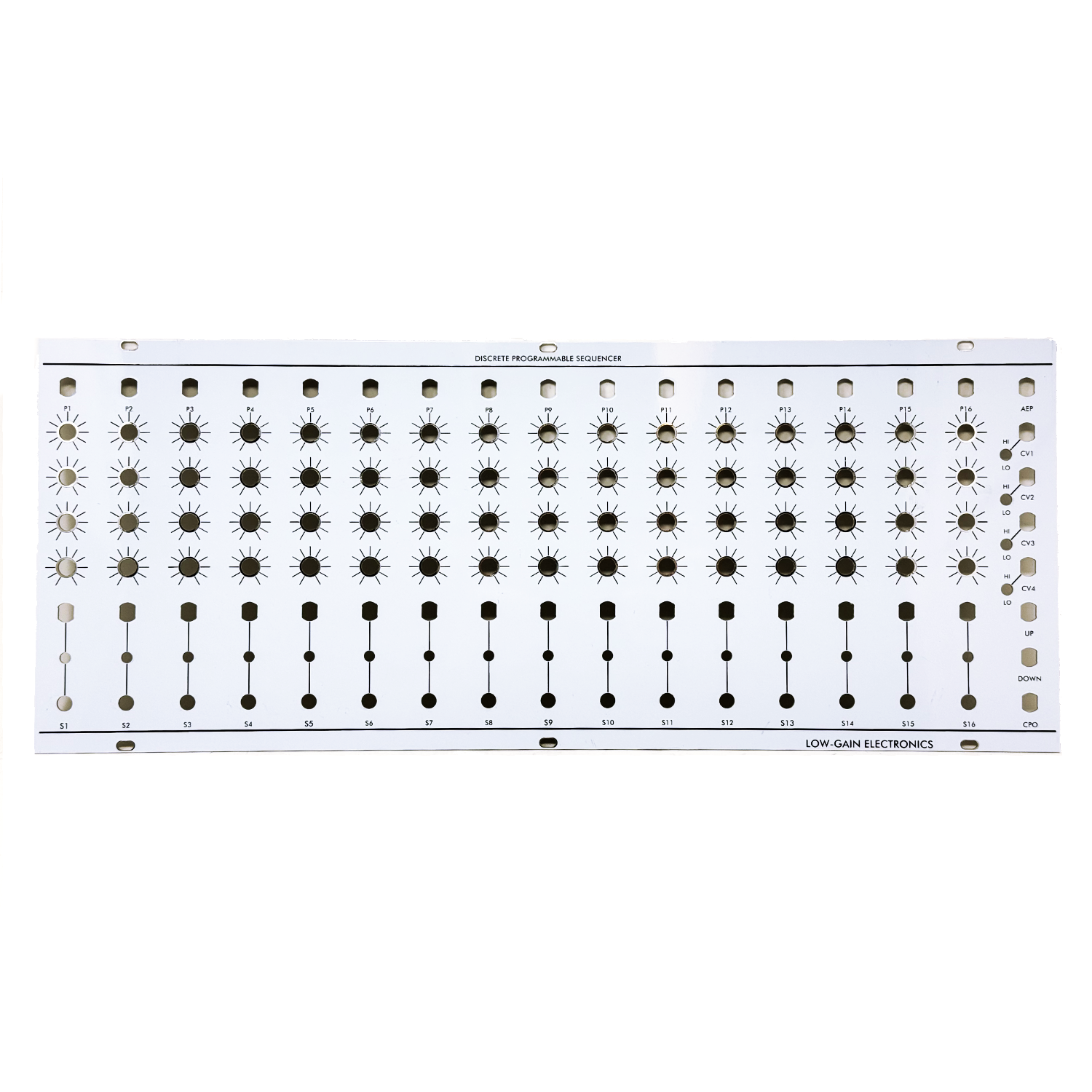 Image 3 of 6
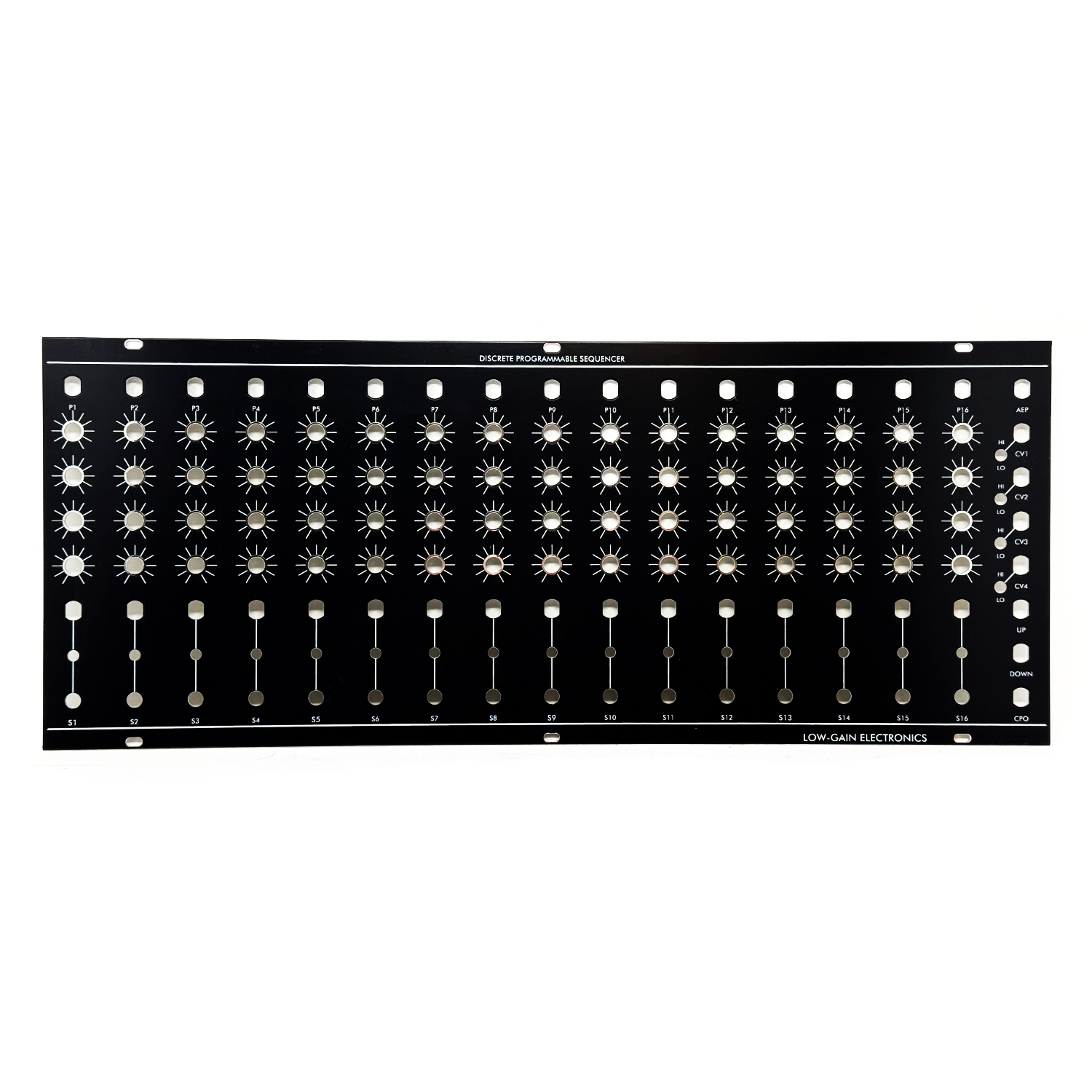 Image 4 of 6
 Image 5 of 6
 Image 6 of 6
The Programmer / Sequencer is a Serge-inspired multi-stage sequencer built around direct stage access rather than counter-based sequencing.
Unlike most sequencers that rely on binary counters or shift registers, each stage here exists as its own independent element. Any stage can be addressed directly, allowing for a more flexible and “random access” approach to sequencing.
Historically, early Serge systems used a CD4017 decade counter to generate gate pulses, which were then routed into a multi-stage programmer to produce control voltages. These programmers were typically arranged in small groups, with only one stage active at a time, sending its programmed voltage to a shared output bus. Stage selection could be handled either by incoming pulses or by pressing panel buttons.
This module builds on that programmer concept and extends it into a more open-ended sequencing tool.
Sequencing & Control
The module does not require a traditional clock, but it does require pulses to advance.
UP and DOWN inputs accept pulses that step the sequence forward or backward
Both inputs can be used at the same time for more complex behavior
Any stage can be activated directly via its Stage Address input or panel button
Once a stage is selected, incoming UP or DOWN pulses will continue stepping from that point.
Each stage also provides its own gate output, making it easy to derive timing, trigger events, or patch custom sequence logic.
Patch-Defined Sequence Length
There is no fixed sequence length. Instead, sequences are defined through patching.
By routing the gate output of any stage back into the address input of another stage, you can create loops of any length or structure. The “first” stage in a sequence does not need to be the first stage on the panel. This allows for:
Intro sections that play once
Loops that begin mid-panel
Non-linear or branching sequences
The structure is entirely determined by how you patch it.
How it works
Each stage shares a common current bus (Bus “C”), which acts as a priority system.
Only one stage can be active at a time. When a new stage is triggered, it takes control of the current source, forcing the previously active stage to reset. This keeps transitions clean without relying on digital counters or scanning logic.
Each stage also contains its own pulse generation circuitry for UP and DOWN operation. These circuits are only active while that stage is selected. When an UP or DOWN pulse is received, the active stage generates a trigger to the next or previous stage accordingly.
Outputs
Per-Stage Gate Outputs
Each stage provides a dedicated gate output for patching, sequencing logic, or event generationCPO (Common Pulse Out)
Goes high while a stage button is held. Effectively a manual gate outputAEP (All Event Pulse)
Outputs a trigger whenever the active stage changes
In practice
This sits somewhere between a programmer and a sequencer. It’s less about fixed-step clocked patterns and more about control, interaction, and patch-defined structure.
It excels at:
Non-linear sequencing
Direct stage addressing
Patch-programmed sequence lengths
Complex stepping using UP and DOWN pulse control
A very “Serge way” of thinking about sequencing, where the patch defines the behavior.
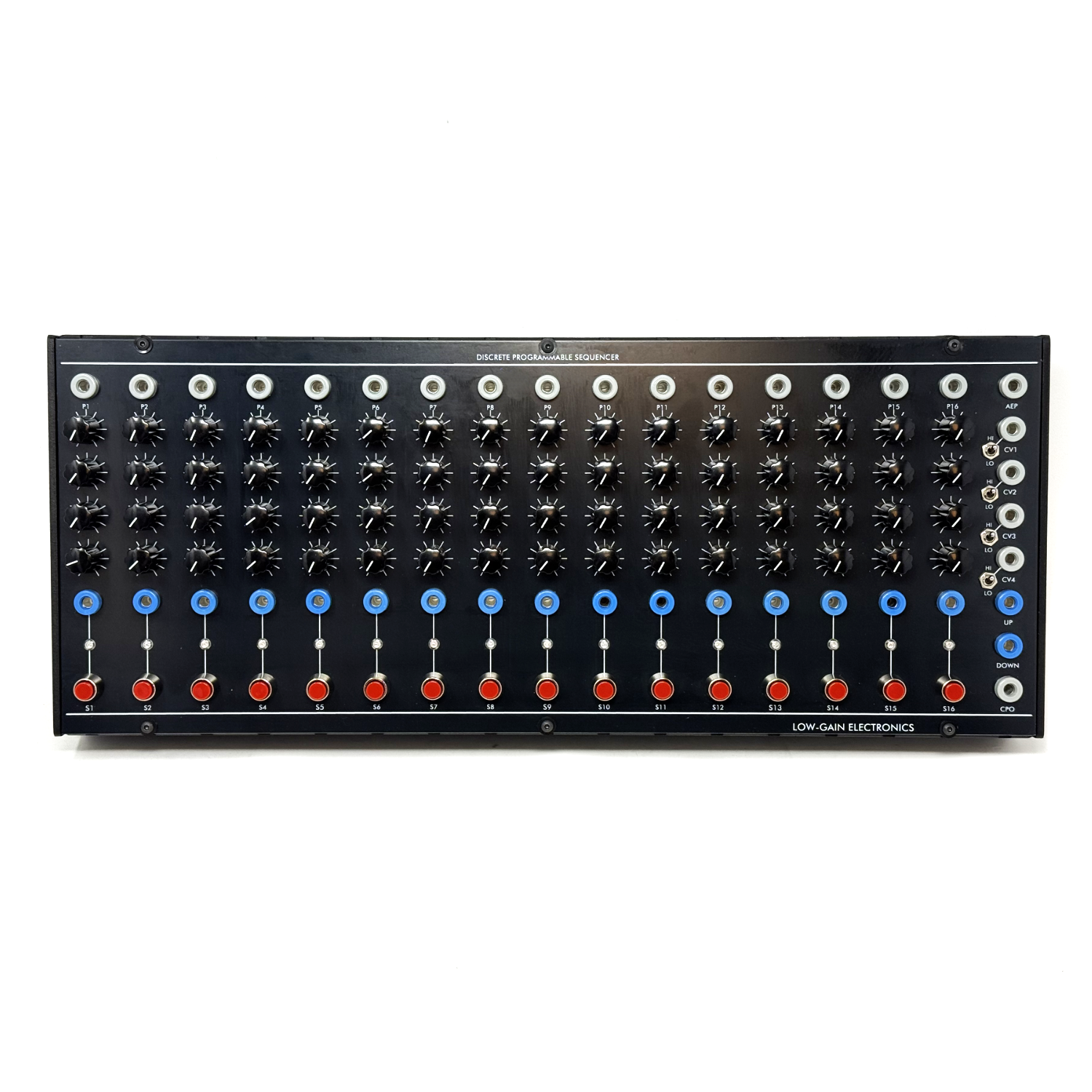
The 16 Stage Programmer Sequencer offers 4 channels of 16 stage CV sequencing with optional range switches to switch between 0-5V and 0-10V operation (Normally just 0-5V).
Assembled System Panel comes mounted in a powered aluminum boat and rack ears.
DIY PCB/Panel set includes: (FIRST BATCH OF DIY PANELS HAVE MINOR MANUFACTUR NUMBER LABEL ERROR BUT CAN BE REMOVED CAREFULLY)
(1) 16 Stage Discrete Programmer Sequencer Panel (White)
(16) LGE059 Programmer Sequence Stage PCB’s
(1) LGE059C Programmer Sequencer Output PCB’s
Build documentation can be found here: Click Here
DIY PCB/Panel Set does NOT include any parts to assemble panel or pcb’s. Only the PCB’s and the panel. Boat/power not included.
All PCB’s mount to the panel w/o any need for a PCB bracket system. Fit’s into a 2-3” Bud Boat.