
 Image 1 of 3
 Image 2 of 3
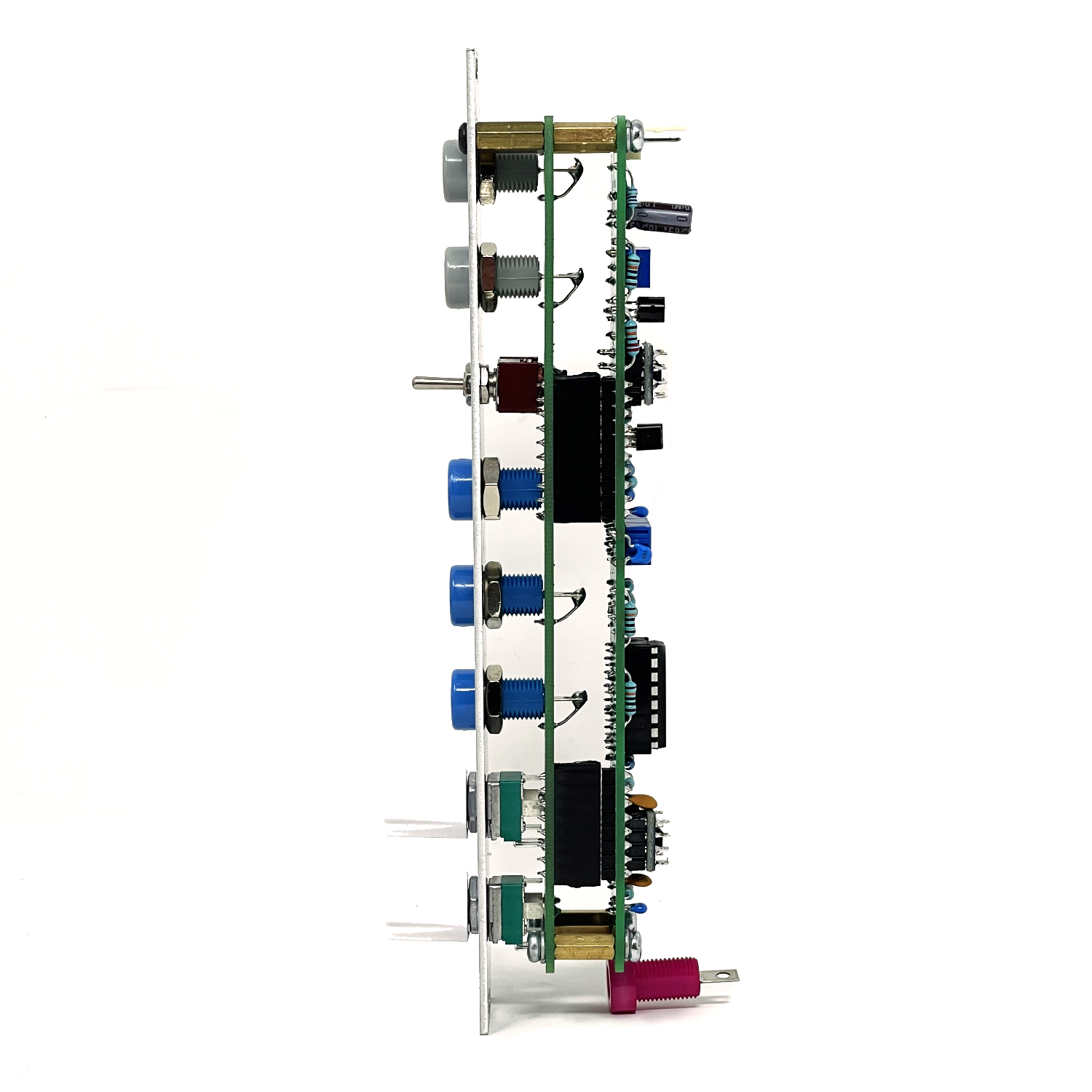 Image 3 of 3
LGE201P Pan/Fade - Voltage-Controlled Panning & Crossfading
The Low-Gain Electronics LGE201P Pan/Fade is a dual-purpose voltage-controlled utility based on the classic Serge Active Processor concept. It combines two essential functions into a compact module: a linear VC panner and a voltage-controlled crossfader, allowing it to process both audio and control voltages with the same precision.
A front-panel PAN/FADE switch instantly changes the operating mode, making the module equally at home as a stereo panner, signal router, or CV crossfader.
Unlike VCAs that simply control amplitude, the Pan/Fade continuously redistributes signal level between two paths, making it ideal for creating movement, blending modulation sources, or morphing between audio signals.
Panel Controls & Connections
Input 1: Primary signal input used in both operating modes.
Input 2: Second signal input used only in Fade Mode.
VC Input: Accepts an external control voltage to automate panning or crossfading. This input sums with the front-panel Bias control, allowing manual offset and voltage control simultaneously.
Pan/Fade Bias: Sets the manual position of the pan or crossfade. With no external CV applied, this functions as a manual control. When CV is present, it acts as an offset, shifting the operating range.
PAN/FADE Switch: Selects the module's operating mode.
Pan Mode
Routes Input 1 between Output 1 and Output 2
Input 2 is disconnected
Both outputs remain active, with the signal smoothly distributed between them
Excellent for stereo panning, voltage-controlled routing, or creating animated signal movement
Fade Mode
Crossfades between Input 1 and Input 2
Only Output 1 is used
Produces a smooth linear blend between two audio or CV sources
Ideal for waveform morphing, switching modulation sources, or blending control voltages
Designed for Audio & Control Voltages
Like the original Serge Modular Music Systems Active Processor, the Pan/Fade works equally well with audio signals and control voltages.
Typical applications include:
Voltage-controlled stereo panning
Crossfading between oscillators or filters
Morphing between modulation sources
Automated routing
Dynamic mixing of CV signals
Creating evolving stereo movement
Operating Notes
The Pan/Fade follows the behavior of the original Serge Active Processor circuit.
Because the Bias control and external VC input are summed together, applying a positive control voltage while the Bias control is already near its maximum position can drive one side of the circuit beyond unity gain. This is a characteristic of the original design rather than a fault, and users may notice the second VCA becoming slightly louder than unity under these conditions.
The same behavior can also be found in the classic Serge Stereo Mixer and other Active Processor-derived circuits. The module has intentionally been left faithful to the original design, preserving both its response and patching characteristics.
Inspired by the Original Serge Design
The Pan/Fade traces its roots to the classic SMMS Active Processor, a utility originally designed as a precision linear crossfader for both audio and control voltages. While remaining true to that philosophy, the LGE201P expands the concept by adding a dedicated voltage-controlled panning mode, making it an even more flexible utility for modern Serge-compatible systems.
Whether blending modulation sources, animating stereo images, or routing signals under voltage control, the Pan/Fade is one of those deceptively simple modules that quickly becomes indispensable.
** 4U Modular is a term used for the format most commonly known as “Serge Format” or “Loudest Warning Format”. Out of respect for the ever growing format, 4U Modular is the easiest way to refer to it. More Specifically it refers to the panel height and mounting hole style. 4U Modular will patch up just fine with other 4U "Serge" formats such as "Random Source", but it will not mount in RS boats or Buchla Boats (or power off Buchla power for that matter). An info page about this will be added to the website soon to make this a lot more easy to understand.
LGE201P Pan/Fade DIY Information:
LGE201P Bill of Materials (Contains both Main & I/O Boards)
LGE201P Main PCB Schematic
LGE201P Main PCB Designators
LGE201PC I/O PCB Schematic
LGE201PC I/O PCB Designators
Calibration: Read Me
Mechanical Parts BOM generally required for building Low-Gain Electronics Modules
One thing to understand about this type of circuit… like the Universal Audio processor, ACP or other similar circuits: If your Pan/Fade Bias control is in the full clockwise position, and you are
feeding CV In, you will get more gain from the 2nd VCA than unity because of the nature of summing both the Bias CV as well as the external CV. It’s just the nature of the circuit. If you’re building the module. you could consider
a 5V1 Zener Diode from Pin 6 of U2 to ground. I haven’t tested this, but it may help. But it’s current based not voltage so a current limiter would probably be more
appropriate. It’s how the original circuit works, and I wanted to make sure the users aren’t scratching their head thinking it’s not working correctly. This
is also the same issue on the Stereo Mixer. It has a reputation of having a very hot output.
Details:
1 Column
PCB Size: 6” x 1”
Current Draw: TBD